 Discovery
Gigantic Gravity "Lenses" Magnify Galaxies Far, Far Away
Submillimeter observatories penetrate cold, dusty galaxies to see stars forming in the primeval past
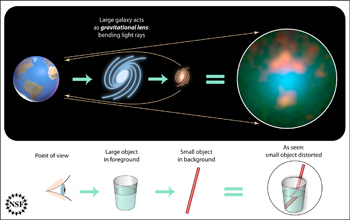
This diagram illustrates a cosmic phenomenon known as gravitational lensing.
Credit and Larger Version |
November 19, 2010
A chance alignment of galaxies, recently observed by a
space observatory, presents the perfect opportunity for studying
star-forming galaxies billions of light-years away.
For decades,
astronomers have used Einstein's concept of a "gravitational lens" to
study the magnified images of distant objects. A lensing effect occurs
when a massive object, such as a galaxy, is located exactly between
another object and an observer.
Because the galaxy in front is so
massive, its strong gravitational pull bends the light coming from
behind it, creating distorted images of the background galaxy.
Sometimes,
the image is so warped that it appears as a ring or arc around the
foreground galaxy. Other times the result is repeated images of the
background galaxy, similar to what happens when looking in a funhouse
mirror. But in all cases, the distorted images are magnified, making the
background galaxies appear brighter and therefore easier to study.
The
universe contains billions of galaxies, but getting the chance
alignment that produces a gravity lens is something like finding a
needle in the haystack. Scientists must sift through large volumes of
data to discover only a few possibilities, and then study these further
to verify that a lensing event has occurred.
"Since about 1978,
astronomers probably have found about 200 gravitational lensing events,
but that involved a very slow search through lots and lots of data,"
said Asantha Cooray, Professor of Physics and Astronomy at University of
California in Irvine. He and dozens of other scientists from around
the world collaborated on a recent project to make the process faster.
Largest space mirror
Using
data collected by the Herschel Astrophysical Terahertz Large Area
Survey (Herschel‑ATLAS) the team of researchers have demonstrated a way
to quickly and easily find strong gravitational lensing events with
close to 100 percent efficiency.
Herschel is a European Space
Agency (ESA) mission with significant participation from NASA. It was
launched in May of 2009, and now orbits a distant point about 1.5
million kilometers (930,000 miles) from Earth on the opposite side of
our planet from the sun.
Because Herschel's mirror is the largest
astronomy mirror ever launched in space (3.5 meters, or about 11.5 feet
across), it can take the sharpest pictures to date at the wavelengths it
detects.
"Herschel-ATLAS is aimed at understanding how stars form
inside galaxies and to shed some light on the past history of galaxy
growth," said Cooray who is now the lead US (NASA) investigator for
Herschel-ATLAS. Cooray is supported by a CAREER award from the National
Science Foundation (NSF).
Cold, dusty star factories
"Astronomers
believe most galaxies undergo a rapid phase of star-formation where
hundreds to a thousand stars are born within a galaxy over a year, with
such activity lasting over a total period of a few to several million
years," Cooray said.
"This phase involves stars that are formed in
clouds enshrouded by dust," he said. "Unfortunately existing ground and
space-based observatories miss most of this picture since they operate
at optical wavelengths and optical light cannot penetrate dust clouds to
see the young stars inside."
Seeing the (submillimeter) light
Although
the background galaxy behind a gravitational lens often can't be seen
by visible light telescopes, these ancient objects still glow with
radiant energy in what's called the submillimeter range-wavelengths of
light from about 0.3 millimeters to 1 millimeter. The Herschel
observatory was specifically designed to detect energy at submillimeter
wavelengths, between the microwave and far-infrared regions of the
electromagnetic spectrum.
In a recent article in the journal
Science,
Cooray and the rest of the team describe how they used data from the
Herschel-ATLAS survey, along with instruments at several ground-based
observatories all over the world, to search out and pin down these dim
star factories.
Using maps made by Herschel, the researchers chose
five gravitational lens "candidates." These were the brightest spots
they could find in the submillimeter-wave images taken of just one small
section of the universe.
"To demonstrate that these bright
galaxies are indeed lensing alignments of a more distant faint galaxy
magnified by an intervening massive galaxy, we needed to establish the
distances to both the background galaxy seen in Herschel and the
foreground galaxy seen in optical images along the same sky directions,"
Cooray said.
To calculate these distances, they tested each candidate for redshift.
A shift in the red direction
Redshift
is caused by the expansion of space as the universe ages. The further
away an object, the longer its wavelengths stretch. Because red light
has longer wavelengths than other visible light, the phenomenon is
called redshift.
To measure redshift of the galaxies, NSF contributed support for two critical instruments: The
Z-Spec, located at the Caltech Submillimeter Observatory (CSO), on the summit of Mauna Kea in Hawaii, and the
Zpectrometer, at the National Radio Astronomy Observatory's Green Bank Telescope (GBT) in West Virginia.
According
to Andrew Harris, professor at the University of Maryland's Department
of Astronomy, the two instruments were named after the letter ‘z," which
in astrophysics is used as a symbol of redshift. Harris is the primary
investigator for the Zpectrometer, at GBT.
"The goal of this
project was to build a ‘redshift machine' that can find the redshifts of
distant galaxies with very little additional information," Harris said.
"Then we can use the information from the spectra to understand the
galaxies' interstellar media."
Galactic fingerprints
Both
the Z-Spec and the Zpectrometer measure the spectral lines of incoming
radiation. Spectral lines are patterns of light or dark lines that show
up at specific wavelengths for specific atoms or molecules. These lines
can be used as a signature or fingerprint, to identify the types of
gases found in the galaxy being measured.
The instruments measure
the redshift by measuring the change in wavelength of these spectral
lines caused by the expansion of the universe. Greater distance means
greater redshift.
"Of course, to measure a change in wavelength,
you must first know what the original wavelength was," said James
Aguirre, professor at the University of Pennsylvania and Primary
Investigator for the Z-Spec at CSO. "This is greatly helped if we can
identify an emission line whose identity is known, and for which we know
the emission wavelength at rest from laboratory measurements."
Because
carbon monoxide (CO) is abundant in distant galaxies, scientists use it
to as a "fingerprint" to calculate the redshift of a galaxy.
"You
can think of the CO spectral lines as marking on a ruler, which
stretches depending on the distance of the galaxy," Aguirre said.
"Measuring the amount of stretch gives the redshift."
"The larger
the redshift the farther away the galaxy," Cooray said. "The galaxies
that we have found are at redshifts around 3, which roughly correspond
to an age of the universe about 2 to 3 billion years--that's about 11
billion years into the past from today."
Lenses confirmed
Aguirre
and the Z-Spec team at the Caltech Submillimeter Observatory observed
three of the five lens candidates and detected redshifts which were
higher than and inconsistent with the redshifts derived from the optical
spectroscopy of the visible, foreground galaxy.
"Z-Spec has
specifically shown these three Herschel-ATLAS galaxies are at high
redshift," said Aguirre. "Armed with this fact, other researchers were
able to confirm that the brightest galaxies in the survey are being
gravitationally lensed."
Meanwhile, the Zpectrometer team at the
Green Bank Telescope was able to independently confirm the distance of
one of the five galaxies, and to measure the distance of another.
"We
showed all five of the bright galaxies seen by Herschel are lensed,
which is not true for example when we look at optical images of the
sky," Cooray said. Without Herschel, these lens events would have been
completely missed.
Understanding the stars
"Given
that we found five lensed galaxies easily with only two percent of our
final map covered, the expectation is that we will find hundreds of such
events with Herschel," Cooray said.
And with these multiple
lenses, the scientists hope to tunnel further into the past, in order to
better understand the history of the early universe.
"Big
galaxies in this early era are unexpected because of our current model
of mass assembly in the universe," said Harris, "So finding and
explaining the existence of very massive young galaxies provides tight
constraints on the models that drive our understanding."
Investigators
Asantha Cooray
Andrew Harris
James Aguirre


 Corals that host fewer species of algae are less sensitive to disturbances
