| Science World at Telus World of Science |
 |
|
|
| Established |
1977 |
| Location |
Vancouver, British Columbia |
| Coordinates |
49.273251°N 123.103767°W |
| Type |
Science museum |
| Visitor figures |
650,000 annually |
| Website |
http://www.scienceworld.ca/ |
Science World at Telus World of Science, Vancouver is a science centre run by a not-for-profit organization in Vancouver, British Columbia, Canada. It is located at the end of False Creek, and features many permanent interactive exhibits and displays, as well as areas with varying topics throughout the years.
The building's former name,
Science World, is still the name of the organization. The building's name change to the Telus World of Science became official on July 20, 2005 following a $9-million donation to the museum from Telus.
[1]
The official name of the science centre was subsequently changed to
"Telus World of Science", although it is still routinely referred to as
"Science World" by the public. Prior to the building behing handed over
to Science World by the City, it was the as
Expo Centre during Expo 86.
When Science World is operating out of the dome, it is referred to as
Science World at TELUS World of Science, and when it is out in the
community it is simply Science World.
Science World outside of TELUS World of Science
Science World also runs programs at Aberdeen Centre in Richmond, BC, and around the province, including locations as remote as Haida Gwaii and Ladysmith.
[citation needed]
History
In 1977, Barbara Brink ran mobile hands-on exhibits known as the
Extended I around the Lower Mainland. Later, the temporary
Arts, Sciences & Technology Centre
opened in downtown Vancouver on January 15, 1982 attracting over
600,000 visitors. Another 400,000 benefited from the centre’s outreach
programs, which were delivered around the province.
When Vancouver was awarded to host the transportation-themed 1986 World's Fair (Expo 86), a Buckminster Fuller
inspired geodesic dome was designed to serve as the fair's Expo Centre
with construction beginning in 1984 and being completed by early 1985.
After Expo closed its gates in October of that year, an intensive
lobbying campaign was launched to secure the landmark building, relocate
the "Arts, Sciences and Technology Centre" into the post-expo dome, and
convert the Expo Centre into Science World. With much government
backing, the dome was obtained from the province and a massive
fund-raising campaign ensued. Donations from the federal, provincial and
municipal governments, the GVRD, the private sector, foundations, and
individuals contributed $19.1 million to build an addition to the Expo
Centre, redesign the interior and fabricate exhibits. In 1988, in a four
month preview, over 310,000 visitors came to see the new building. A
year later, The 400 seat OMNIMAX
theatre in the upper section of the dome was opened, extending upon the
3D IMAX theatre which was built in 1986 for the Expo "Transitions" film
series.
[2]
The centre entered its first title sponsorship agreement with Alcan Inc. in 1996, renaming its OMNIMAX Theatre the
Alcan OMNIMAX
Theatre. Alcan has since decided to sponsor the organization in
different ways and the theatre has returned to its original name, the
OMNIMAX Theatre. In January 2005, the building was officially renamed
"Telusphere" as part of an agreement where Telus gave a $9-million
donation in return for the "naming rights" of the building. This new
name proved universally unpopular. In the summer of 2005, Telus and
Science World officially changed the name of the building to the
Telus World of Science.
This maintained consistency with other "Telus World of Science" centres
in Calgary and Edmonton that were named in the meantime. This name
change has not affected the nearby SkyTrain station and the general public still refers to it as Science World.
During the 2010 Vancouver Winter Olympics, Science World was transformed into the Russky Dom (also known as Sochi.ru World)
[3],
which profiled plans for the 2014 Winter Olympics in Sochi, Russia.
From February 12 to 28, 2010, the general public was allowed into the
Russky Dom from noon until 5 p.m. In the evenings, parties were held in
the Russky Dom for accredited guests.
Science World underwent renovation after the 2010 Winter Olympics.
The indoor renovations are complete as of mid-2012 and the adjacent Ken
Spencer Science Park is scheduled to be finished construction in late
2012.
[4]


 ASSEMBLY LINE
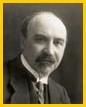 Leo
Hendrik Baekeland (November 14, 1863 - February 23, 1944) was a
Belgian-born American chemist who invented Velox photographic paper
(1893) and Bakelite (1907), an inexpensive, nonflammable, versatile, and
very popular plastic.
For more information on Baekeland, click here.
Leo
Hendrik Baekeland (November 14, 1863 - February 23, 1944) was a
Belgian-born American chemist who invented Velox photographic paper
(1893) and Bakelite (1907), an inexpensive, nonflammable, versatile, and
very popular plastic.
For more information on Baekeland, click here.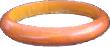 Bakelite
(also called catalin) is a plastic, a dense synthetic polymer (a
phenolic resin) that was used to make jewelry, game pieces, engine
parts, radio boxes, switches, and many, many other objects. Bakelite was
the first industrial thermoset plastic (a material that does not change
its shape after being mixed and heated). Bakelite plastic is made from
carbolic acid (phenol) and formaldehyde, which are mixed, heated, and
then either molded or extruded into the desired shape.
Bakelite was patented in 1907 by the Belgian-born American chemist Leo
Hendrik Baekeland (November 14, 1863 - February 23, 1944). The Nobel
Prize winning German chemist Adolf von Baeyer had experimented with this
material in 1872, but did not complete its development or see its
potential.
Bakelite
(also called catalin) is a plastic, a dense synthetic polymer (a
phenolic resin) that was used to make jewelry, game pieces, engine
parts, radio boxes, switches, and many, many other objects. Bakelite was
the first industrial thermoset plastic (a material that does not change
its shape after being mixed and heated). Bakelite plastic is made from
carbolic acid (phenol) and formaldehyde, which are mixed, heated, and
then either molded or extruded into the desired shape.
Bakelite was patented in 1907 by the Belgian-born American chemist Leo
Hendrik Baekeland (November 14, 1863 - February 23, 1944). The Nobel
Prize winning German chemist Adolf von Baeyer had experimented with this
material in 1872, but did not complete its development or see its
potential.
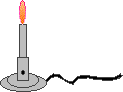
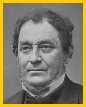 The
laboratory Bunsen burner was invented by Robert Wilhelm Bunsen in 1855.
Bunsen (1811-1899) was a German chemist and teacher. He invented the
Bunsen burner for his research in isolating chemical substances - it has
a high-intensity, non-luminous flame that does not interfere with the
colored flame emitted by chemicals being tested.
For more information on Bunsen, click here.
The
laboratory Bunsen burner was invented by Robert Wilhelm Bunsen in 1855.
Bunsen (1811-1899) was a German chemist and teacher. He invented the
Bunsen burner for his research in isolating chemical substances - it has
a high-intensity, non-luminous flame that does not interfere with the
colored flame emitted by chemicals being tested.
For more information on Bunsen, click here.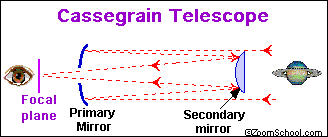 CASSEGRAIN TELESCOPE
 CELSIUS, ANDERS
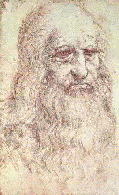 Leonardo
da Vinci (1452-1519) was an Italian inventor, artist, architect, and
scientist. Da Vinci had an interest in engineering and made detailed
sketches of the airplane, the helicopter (and other flying machines),
the parachute,
the submarine, the armored car, the ballista (a giant crossbow),
rapid-fire guns, the centrifugal pump (designed to drain wet areas, like
marshes), ball bearings, the worm gear (a set of gears in which many
teeth make contact at once, reducing the strain on the teeth, allowing
more pressure to be put on the mechanism), and many other incredible
ideas that were centuries ahead of da Vinci's time.
For some da Vinci art coloring pages, click here
Leonardo
da Vinci (1452-1519) was an Italian inventor, artist, architect, and
scientist. Da Vinci had an interest in engineering and made detailed
sketches of the airplane, the helicopter (and other flying machines),
the parachute,
the submarine, the armored car, the ballista (a giant crossbow),
rapid-fire guns, the centrifugal pump (designed to drain wet areas, like
marshes), ball bearings, the worm gear (a set of gears in which many
teeth make contact at once, reducing the strain on the teeth, allowing
more pressure to be put on the mechanism), and many other incredible
ideas that were centuries ahead of da Vinci's time.
For some da Vinci art coloring pages, click here
 Sir
Humphry Davy (1778-1829) was an English scientist who invented the
first electric light in 1800. He experimented with electricity and
invented an electric battery. When he connected wires from his battery
to two pieces of carbon, electricity arced between the carbon pieces,
producing an intense, hot, and short-lived light. This is called an
electric arc. Davy also invented a miner's safety helmet and a process
to desalinate sea water. Davy discovered the elements boron, sodium,
aluminum (whose name he later changed to aluminium), and potassium.
Sir
Humphry Davy (1778-1829) was an English scientist who invented the
first electric light in 1800. He experimented with electricity and
invented an electric battery. When he connected wires from his battery
to two pieces of carbon, electricity arced between the carbon pieces,
producing an intense, hot, and short-lived light. This is called an
electric arc. Davy also invented a miner's safety helmet and a process
to desalinate sea water. Davy discovered the elements boron, sodium,
aluminum (whose name he later changed to aluminium), and potassium.
 FARNSWORTH, PHILO T.
 Jean Bernard Léon Foucault (1819-1868) was a French physicist who invented the gyroscope
(1852) and the Foucault pendulum (1851). A gyroscope is essentially a
spinning wheel set in a movable frame. When the wheel spins, it retains
its spatial orientation, and it resists external forces applied to it.
Gyroscopes are used in navigation instruments (for ships, planes, and
rockets). Foucault was the first person to demonstrate how a pendulum
could track the rotation of the Earth (the Foucault pendulum) in 1851.
He also showed that light travels more slowly in water than in air
(1850) and improved the mirrors of reflecting telescopes (1858).
Jean Bernard Léon Foucault (1819-1868) was a French physicist who invented the gyroscope
(1852) and the Foucault pendulum (1851). A gyroscope is essentially a
spinning wheel set in a movable frame. When the wheel spins, it retains
its spatial orientation, and it resists external forces applied to it.
Gyroscopes are used in navigation instruments (for ships, planes, and
rockets). Foucault was the first person to demonstrate how a pendulum
could track the rotation of the Earth (the Foucault pendulum) in 1851.
He also showed that light travels more slowly in water than in air
(1850) and improved the mirrors of reflecting telescopes (1858).
 Benjamin
Franklin (January 17, 1706-April 17, 1790) was an American statesman,
writer, printer, and inventor. Franklin experimented extensively with
electricity. In 1752, his experiments with a kite in a thunderstorm
(never do this, many people have died trying it!) led to the development
of the lightning rod. Franklin started the first circulating library
in the colonies in 1731. He also invented bifocal glasses and the
Franklin stove. The idea of daylight savings time was first proposed by
Benjamin Franklin in 1784.
For more information on Franklin, click here.
Benjamin
Franklin (January 17, 1706-April 17, 1790) was an American statesman,
writer, printer, and inventor. Franklin experimented extensively with
electricity. In 1752, his experiments with a kite in a thunderstorm
(never do this, many people have died trying it!) led to the development
of the lightning rod. Franklin started the first circulating library
in the colonies in 1731. He also invented bifocal glasses and the
Franklin stove. The idea of daylight savings time was first proposed by
Benjamin Franklin in 1784.
For more information on Franklin, click here. Galileo Galilei (1564-1642) was an Italian mathematician, astronomer,
and physicist. Galileo found that the speed at which bodies fall does
not depend on their weight and did extensive experimentation with
pendulums.
In 1593 Galileo invented the thermometer.
Galileo Galilei (1564-1642) was an Italian mathematician, astronomer,
and physicist. Galileo found that the speed at which bodies fall does
not depend on their weight and did extensive experimentation with
pendulums.
In 1593 Galileo invented the thermometer.
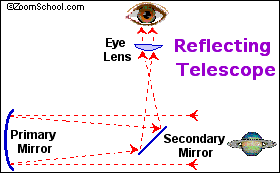
 to observe the skies (after hearing about Hans Lippershey's newly-invented telescope). Galileo discovered the rings of Saturn (1610), was the first person to see the four major moons of Jupiter (1610), observed the phases of Venus, studied sunspots, and discovered many other important phenomena.
 GREGORY, JAMES
 HERON
HERON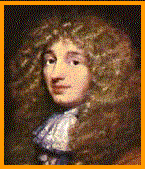 Christian Huygens (1629-1695) was a Dutch physicist and astronomer
who developed new methods for grinding and polishing glass telescope
lenses (about 1654). With his new, powerful telescopes, he identified
Saturn's rings and discovered Titan, the largest moon of Saturn
in 1655. Huygens also invented the pendulum clock in 1656 (eliminating
springs), wrote the first work on the calculus of probability (De
Ratiociniis in Ludo Aleae, 1655), and proposed the wave theory of light
(Traité de la lumiere, 1678).
Christian Huygens (1629-1695) was a Dutch physicist and astronomer
who developed new methods for grinding and polishing glass telescope
lenses (about 1654). With his new, powerful telescopes, he identified
Saturn's rings and discovered Titan, the largest moon of Saturn
in 1655. Huygens also invented the pendulum clock in 1656 (eliminating
springs), wrote the first work on the calculus of probability (De
Ratiociniis in Ludo Aleae, 1655), and proposed the wave theory of light
(Traité de la lumiere, 1678).
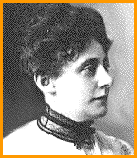 Ida Henrietta Hyde (1857-1945) was an American physiologist who invented the microelectrode
in the 1930's. The microelectrode is a small device that electrically
(or chemically) stimulates a living cell and records the electrical
activity within that cell. Hyde was the first woman to graduate from the
University of Heidelberg, to do research at the Harvard Medical School
and to be elected to the American Physiological Society.
Ida Henrietta Hyde (1857-1945) was an American physiologist who invented the microelectrode
in the 1930's. The microelectrode is a small device that electrically
(or chemically) stimulates a living cell and records the electrical
activity within that cell. Hyde was the first woman to graduate from the
University of Heidelberg, to do research at the Harvard Medical School
and to be elected to the American Physiological Society. JANSKY, KARL
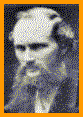 Lord Kelvin (William Thomson, 1824 - 1907) designed the Kelvin scale, in which 0 K is defined as absolute zero and the size of one degree is the same as the size of one degree Celsius. Water freezes at 273.16 K; water boils at 373.16 K.
For more information on Kelvin, click here.
Lord Kelvin (William Thomson, 1824 - 1907) designed the Kelvin scale, in which 0 K is defined as absolute zero and the size of one degree is the same as the size of one degree Celsius. Water freezes at 273.16 K; water boils at 373.16 K.
For more information on Kelvin, click here.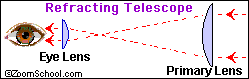 LIPPERSHEY, HANS
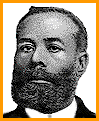 Elijah
McCoy (1843 or 1844-1929) was a mechanical engineer and inventor.
McCoy's high-quality industrial inventions (especially his steam engine
lubricator) were the basis for the expression "the real McCoy," meaning
the real, authentic, or high-quality thing.
For more information on Elijah McCoy, click here. For a cloze activity on McCoy, click here.
Elijah
McCoy (1843 or 1844-1929) was a mechanical engineer and inventor.
McCoy's high-quality industrial inventions (especially his steam engine
lubricator) were the basis for the expression "the real McCoy," meaning
the real, authentic, or high-quality thing.
For more information on Elijah McCoy, click here. For a cloze activity on McCoy, click here. The
microscope may have been invented by eyeglass makers in Middelburg, The
Netherlands, invented sometime between 1590 and 1610. Hans and his son
Zacharias Janssen are mentioned in the letters of William Boreel ( the
Dutch envoy to the Court of France) as having invented a 20X
magnification microscope.
Robert Hooke used an early microscope to observe slices of cork (bark
from
the oak tree) using a 30X power compound microscope. He published his
observations in "Microgphia" in 1665. In 1673, Antony van Leeuwenhoek
discovered bacteria, free-living and parasitic microscopic protists,
sperm cells, blood cells, etc., using a 300X power single lens
microscope.
The
microscope may have been invented by eyeglass makers in Middelburg, The
Netherlands, invented sometime between 1590 and 1610. Hans and his son
Zacharias Janssen are mentioned in the letters of William Boreel ( the
Dutch envoy to the Court of France) as having invented a 20X
magnification microscope.
Robert Hooke used an early microscope to observe slices of cork (bark
from
the oak tree) using a 30X power compound microscope. He published his
observations in "Microgphia" in 1665. In 1673, Antony van Leeuwenhoek
discovered bacteria, free-living and parasitic microscopic protists,
sperm cells, blood cells, etc., using a 300X power single lens
microscope.

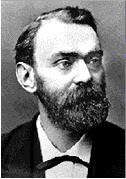 NOBEL, ALFRED
 ROENTGEN, WILHELM VON
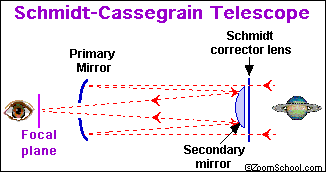 A
Schmidt-Cassegrain telescope (SCT) is a wide-angle reflecting telescope
with a correcting lens that minimizes spherical aberration and a
concave mirror that receives light and focuses an image. A second
mirror reflects the light through a gap in the primary mirror, allowing
the eyepiece or camera to be mounted at the back end of the tube. The Cassegrain telescope
(named for the French sculptor Sieur Guillaume Cassegrain) was
developed in 1672; the correcting plate (a lens) was added in 1930 by
the Estonian astronomer and lens-maker Bernard Schmidt (1879-1935).
A
Schmidt-Cassegrain telescope (SCT) is a wide-angle reflecting telescope
with a correcting lens that minimizes spherical aberration and a
concave mirror that receives light and focuses an image. A second
mirror reflects the light through a gap in the primary mirror, allowing
the eyepiece or camera to be mounted at the back end of the tube. The Cassegrain telescope
(named for the French sculptor Sieur Guillaume Cassegrain) was
developed in 1672; the correcting plate (a lens) was added in 1930 by
the Estonian astronomer and lens-maker Bernard Schmidt (1879-1935).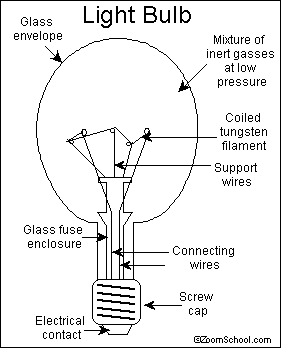
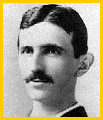 Nikola Tesla (1856-1943) was a Serbian-American inventor who developed the radio,
fluorescent lights, the Tesla coil (an air-core transformer that
generates a huge voltage from high-frequency alternating current),
remote-control devices, and many other inventions; Tesla held 111
patents. Tesla developed and promoted the uses of alternating current
(as opposed to direct current, which was promoted fiercely by Thomas
Edison and General Electric). Tesla briefly worked with Thomas Edison. The unit of magnetic induction is named for Tesla; a tesla (abbreviated T) is equal to one weber per square meter.
For a page on Tesla, click here.
Nikola Tesla (1856-1943) was a Serbian-American inventor who developed the radio,
fluorescent lights, the Tesla coil (an air-core transformer that
generates a huge voltage from high-frequency alternating current),
remote-control devices, and many other inventions; Tesla held 111
patents. Tesla developed and promoted the uses of alternating current
(as opposed to direct current, which was promoted fiercely by Thomas
Edison and General Electric). Tesla briefly worked with Thomas Edison. The unit of magnetic induction is named for Tesla; a tesla (abbreviated T) is equal to one weber per square meter.
For a page on Tesla, click here. WATT, JAMES
 Linus
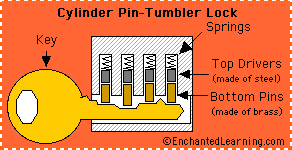
Yale Jr. (1821-1868) was an American mechanical engineer and
manufacturer who developed the cylinder pin-tumbler lock (and other key
and combination locks). Yale's father, Linus Yale, had invented an
earlier pin-tumbler lock in 1848; the son's lock used a smaller, flat
key with serrated edges (like the ones we still use today). There is no
connection between Linus Yale and Yale University.
Linus
Yale Jr. (1821-1868) was an American mechanical engineer and
manufacturer who developed the cylinder pin-tumbler lock (and other key
and combination locks). Yale's father, Linus Yale, had invented an
earlier pin-tumbler lock in 1848; the son's lock used a smaller, flat
key with serrated edges (like the ones we still use today). There is no
connection between Linus Yale and Yale University.